
Houghton House
Chapter 2 : History
Building at Houghton began in 1615, for Lady Mary Herbert (neé Sidney), Countess of Pembroke (1561 – 1621).
Lady Pembroke was herself an extremely talented poet, translator and patron of all forms of literature. Whilst a gentlewoman of Queen Elizabeth’s Privy Chamber, she translated Petrarch, and also the Psalms, completing works begun by her brother.
Lady Pembroke was herself an extremely talented poet, translator and patron of all forms of literature. Whilst a gentlewoman of Queen Elizabeth’s Privy Chamber, she translated Petrarch, and also the Psalms, completing works begun by her brother.
The park and ruins of the House were acquired by the Earl of Upper Ossory in 1804 and landscaped by Capability Brown.
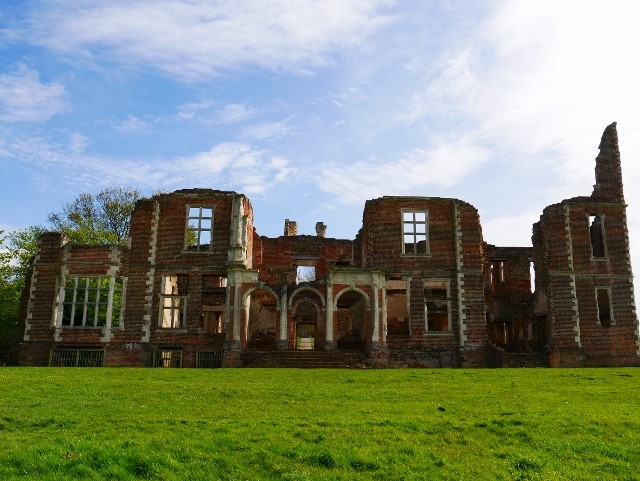
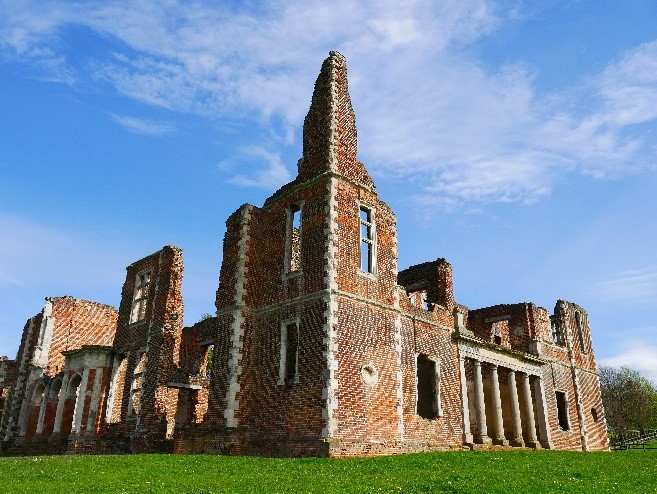
King James granted the land to Lady Pembroke and visited her there in 1621, following completion of the House, which was built as a hunting lodge and pleasure palace. The architect was probably John Thorpe, although Inigo Jones may have had some involvement.
Two years after Lady Pembroke’s death in 1621, Houghton House was granted by James to Thomas Bruce, 1st Earl of Elgin. In 1738, Elgin’s descendent, the Jacobite 2nd Earl of Ailesbury (1656 – 1641) sold it to William Russell, 4th Duke of Bedford. By 1794, the Duke wished to rent the hunting park separately from the house. For some obscure reason, the law forbad letting a park separately from the house so, to get round this, the Duke had the house made unfit for habitation by removing the roof and stripping out the interior.
The park and ruins of the House were acquired by the Earl of Upper Ossory in 1804 and landscaped by Capability Brown.

 Amazon US

 Amazon UK

 Amazon US

 Amazon UK

 Amazon US

 Amazon UK

 Amazon US

 Amazon UK